Saturday, November 2, 2013

Winter 2013/2014 radio broadcasts to North Korea

Winter 2013/2014 radio broadcasts to North Korea

The various public and private radio stations that aim broadcasts at North Korea have just refreshed their broadcast schedules for the winter season.
In addition to the publicly-funded outlets, there are several private stations. Their editorial balance at the stations differ although none are pro-regime stations. Some are jammed by North Korea making reception difficult — but not impossible — inside the country.
Given the right conditions, the broadcasts should be audible across a large part of Northeast Asia and, in some cases, around the world.
All times at UTC and all broadcasts in Korean unless noted.
== International Broadcasters ==
Voice of America
1200 to 1500 (2100 to 0000 local) on 1,188kHz, 5,890kHz, 7,235kHz and 9,800kHz
1900 to 2100 (0400 to 0600 local) on 648kHz, 5,875kHz, 9,390kHz and 9,800kHz
Radio Free Asia
1500 to 1700 (0000 to 0200 local) on 5,855kHz, 7,210kHz, 11585kHz
1700 to 1900 (0200 to 0400 local) on 5,855kHz and 9,720kHz
2100 to 2200 (0600 to 0700 local) on 9,385kHz and 11,995kHz
KBS Social Radio
0400 to 0000 (1300 to 0900 local) on 972kHz and 6,015kHz
1000 to 0400 (1900 to 1300 local) on 1,170kHz
== South Korea to North Korea ==
Free North Korea Radio (자유북한방송)
1530 to 1630 (0030 to 0130 local) on 6,275kHz
Open Radio for North Korea (열린북한방송)
1230 to 1430 (2130 to 2330 local) on 9,910kHz
1900 to 1955 (0400 to 0455 local) on 774kHz and 92.3MHz via MBC Chuncheon
2100 to 2200 (0600 to 0700 local) on 7,470kHz
Radio Free Choson (자유조선방송)
1300 to 1400 (2200 to 2300 local) on 9,300kHz
1400 to 1600 (2300 to 0100 local) on 9,775kHz
North Korea Reform Radio (북한개혁방송)
1400 to 1600 (2300 to 0100 local) on 7,590kHz and 9,380kHz
== Japan to North Korea ==
Shiokaze (しおかぜ)
1330 to 1430 (2230 to 2300 local) on 5,910kHz or 5,985kHz or 6,140kHz via Japan (in Japanese on Mon, Tue, Thu, Fri; Chinese on Wed; English on Sat; Korean on Sun)
1400 to 1430 (2300 to 2330 local) on 5,910kHz or 5,985kHz or 6,140kHz via Japan (in Korean on Mon, Wed; Japanese on Tue, Thu, Fri, Sun; English on Sat)
2000 to 2030 (0500 to 0530 local) on 5,975kHz or 5,985kHz or 6,140kHz via Japan (in Japanese on Mon, Tue, Thu, Fri; Chinese on Wed; English on Sat; Korean on Sun)
2030 to 2100 (0530 to 0600 local) on 5,975kHz or 5,985kHz or 6,140kHz via Japan (in Korean on Mon, Wed; Japanese on Tue, Thu, Fri, Sun; English on Sat)
Furusato no kaze (ふるさとの風)
1330 to 1357 (2230 to 2257 local) on 9950kHz via Taiwan (in Japanese)
1430 to 1500 (2330 to 0000 local) on 9960kHz via Palau (in Japanese)
1600 to 1630 (0100 to 0130 local) on 9780kHz via Taiwan (in Japanese)
Nippon no kaze (日本の風)
1430 to 1500 (2330 to 0000 local) on 9960kHz via Palau
1500 to 1530 (0000 to 0030 local) on 9975kHz via Palau
1530 to 1600 (0030 to 0100 local) on 9965kHz via Palau
== Religious ==
Voice of the Wilderness
1300 to 1400 (2200 to 2300 local) on 11,860kHz (Monday to Saturday)
1300 to 1430 (2200 to 2330 local) on 11,860kHz (Sunday)
1620 to 1635 (0120 to 0135 local) on 1,188kHz (Friday and Saturday)
1900 to 1930 (0400 to 0430 local) on 1,566kHz (Tuesday, Thursday)
1900 to 2000 (0400 to 0500 local) on 1,566kHz (Sunday)
1900 to 2000 (0400 to 0500 local) on 7,375kHz (Monday to Saturday)
1900 to 2030 (0400 to 0530 local) on 7,375kHz (Sunday)
Voice of the Martyrs
1600 to 1730 (0100 to 0230 local) on 7,515kHz

Monday, September 2, 2013

Kim Jong Un visits ‘cell phone factory’

Kim Jong Un visits ‘cell phone factory’

Kim Jong Un visited on Saturday the Pyongyang factory where North Korean cell phones are supposedly made, according to the state-run Korean Central News Agency.
The Android-based AS1201 "Arirang" cell phone, reportedly produced by the May 11 Factory in Pyongyang.
The Android-based AS1201 “Arirang” cell phone, reportedly produced by the May 11 Factory in Pyongyang.
Photos of the visit, released by KCNA, show Kim touring the May 11 Factory and talking to officials. There’s also a picture of what’s said to be the latest cell phone on the North Korean market, an Android phone called “Arirang.” (See right, click for larger image.)
The visit came two years and two weeks since Kim Jong Un last visited the factory. That time he accompanied his father, Kim Jong Il, on a tour of a flat-screen LCD TV assembly line. At the time I noted the production line shown in TV coverage of the visit didn’t look much like those in a typical electronics factory and the same is true this time around.
Workers are shown with finished products, inspecting them and testing them but no actual manufacturing is shown.
Despite KCNA’s reporting that the handsets are made at the factory, they are probably made to order by a Chinese manufacturer and shipped to the May 11 Factory where they are inspected before going on sale.
That will be all but confirmed if the handset shown in the photo can be identified.
Here’s what KCNA said about the visit:
He learned in detail about the performance, quality and packing of “Arirang” hand phone being made at this factory.
He highly appreciated the creative ingenuity and patriotic enthusiasm with which the officials and employees of the factory laid a solid foundation for mass-producing hand phones by building a new modern hand phone production process.
He praised them for developing an application program in Korean style which provides the best convenience to the users while strictly guaranteeing security.
After learning about the performance of a touch hand phone, he said that a hand phone is convenient for its user when that part of the phone is sensitive.
He noted that these hand phones will be very convenient for their users as their camera function has high pixels.
After being told that “Arirang” hand phones which the factory started producing a few days ago are high in demand among people, he said he was also pleased as they are liked by people.
Looking at the trademark “Arirang” inscribed on the hand phone, he noted that mass-production of goods with DPRK trademark can instill national pride and self-respect into the Korean people.
How nice to see hand phones being successfully produced with indigenous technology, he said, adding it is of educational significance in making people love Korean things.
He said that only when the quality of products is improved while boosting their production, people will like home-made things and they will be in high demand. — KCNA, August 11, 2013.
A report on the visit was carried by Korean Central Television, but it didn’t show any video or still images from the trip.
Analysis of the meeting by Daily NK noted the visit is the first time that Kim has “offered the Kim family stamp of approval to the widespread production, and by extension ownership, of cell phones.”
That’s true, although Kim Jong Il’s previous meetings with Naguib Sawiris, chairman of network operator Orascom Telecom, received widespread coverage in state media as did the switching on of the cell phone network.
Daily NK also said it was noteworthy that “Kim posited the idea of cellphone production as a patriotic activity.”
130811-arirang-3
Kim Jong Un on a visit of the May 11 Factory on August 10, 2013.
130811-arirang-2
Kim Jong Un on a visit of the May 11 Factory on August 10, 2013.

Ham radio operators hope to put North Korea on the air

Ham radio operators hope to put North Korea on the air

A group of amateur radio operators are hoping to get permission from the North Korean government for a month-long trip to the country during which they’ll set up a ham radio operation.
If they manage to pull off the plan, they’ll have succeeded where few have before.
North Korea has no amateur radio operators and government-sanctioned transmissions by foreigners in the country are extremely rare. This makes North Korea the rarest country for contacts in the amateur radio world.
The project is still in the planning phase but is being led by operators with experience of both North Korea and operating in usually closed countries. One of the members, David Flack (AH6HY), has been to the DPRK several times and other members helped organize similar trips to Kurdistan, South Sudan and Yemen.
Two of the group are planning to travel to Pyongyang in June and seek permission to bring in two teams of 12 operators and the necessary radios, antennas, power supplies and amplifiers.
The expedition won’t be solely focused on radio activities. They are also running a humanitarian appeal to help the “Love North Korean Children” charity.
Two members of the the group contacted declined an interview request.
There have been several other attempts to get on the air from North Korea. One of the more recent was in 2005.
David Borenstein (KA2HTV), a medical doctor, received advance permission to operate while on a trip to Pyongyang but failed to get on the air. Apparently, an official at the Committee for Cultural Relations with Foreign Countries approved the plan without getting clearance from the Ministry of Telecommunications and Posts, according a statement from his sponsor.
His equipment made it through customs and some of it was then held by the ministry for a week before he was told he could not operate in North Korea, the statement said.
To make matters worse, he didn’t get to return with all of his gear. Early discussions had included talk of a donation to the DPRK of amateur radio equipment, and some of Mr. Borenstein’s own equipment was apparently mistaken for the gear to be donated. He ended up with a receipt from the Committee for Cultural Relations with Foreign Countries thanking him for his “donation” of a radio, antenna, power supply and other gear.
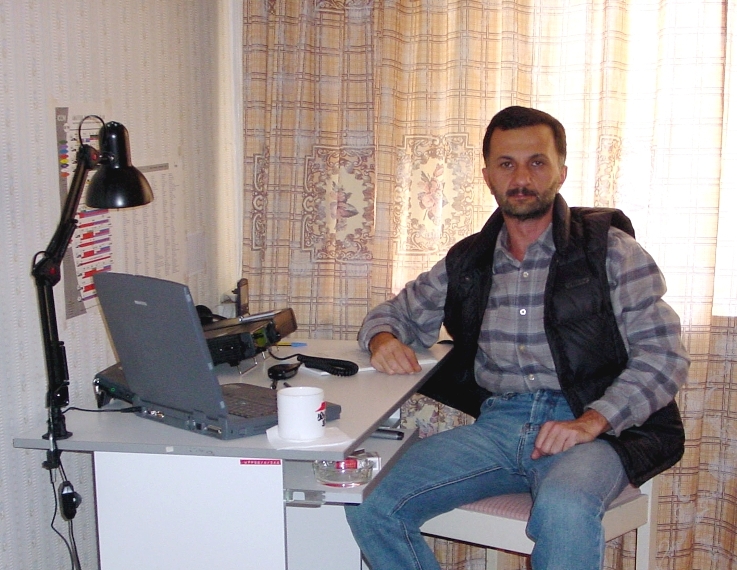
Edisher Giorgadze (4L4FN) operating his amateur radio station in Pyongyang.
The most successful has been Edisher Giorgadze (4L4FN), a Georgian working for the UN World Food Programme in Pyongyang. He received permission to operate while stationed in the country and made more than 16,000 communications with more than 12,000 amateurs around the world.
The station was on the air for just over a year, but was forced to close in November 2002.
According to a news release from the time:
“Friday evening, 2002 November 22, Ed was called into a meeting with the “Radio Regulation Board” without any explanation, he was politely asked to quit all transmissions and pack all his radio equipment. Saturday, he spent all day on the roof disassembling his antennas and packing boxes. At 2:30pm on of the government officials came by, sealed all the boxes and when he leaves on December 10 for his two weeks R&R he is to take everything with him out of the country.”
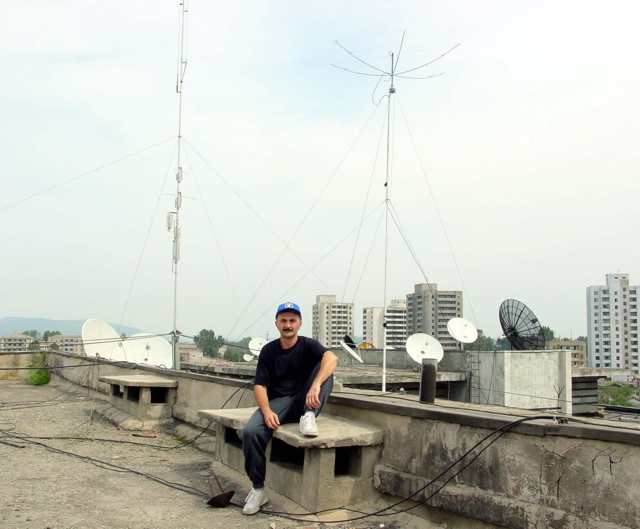
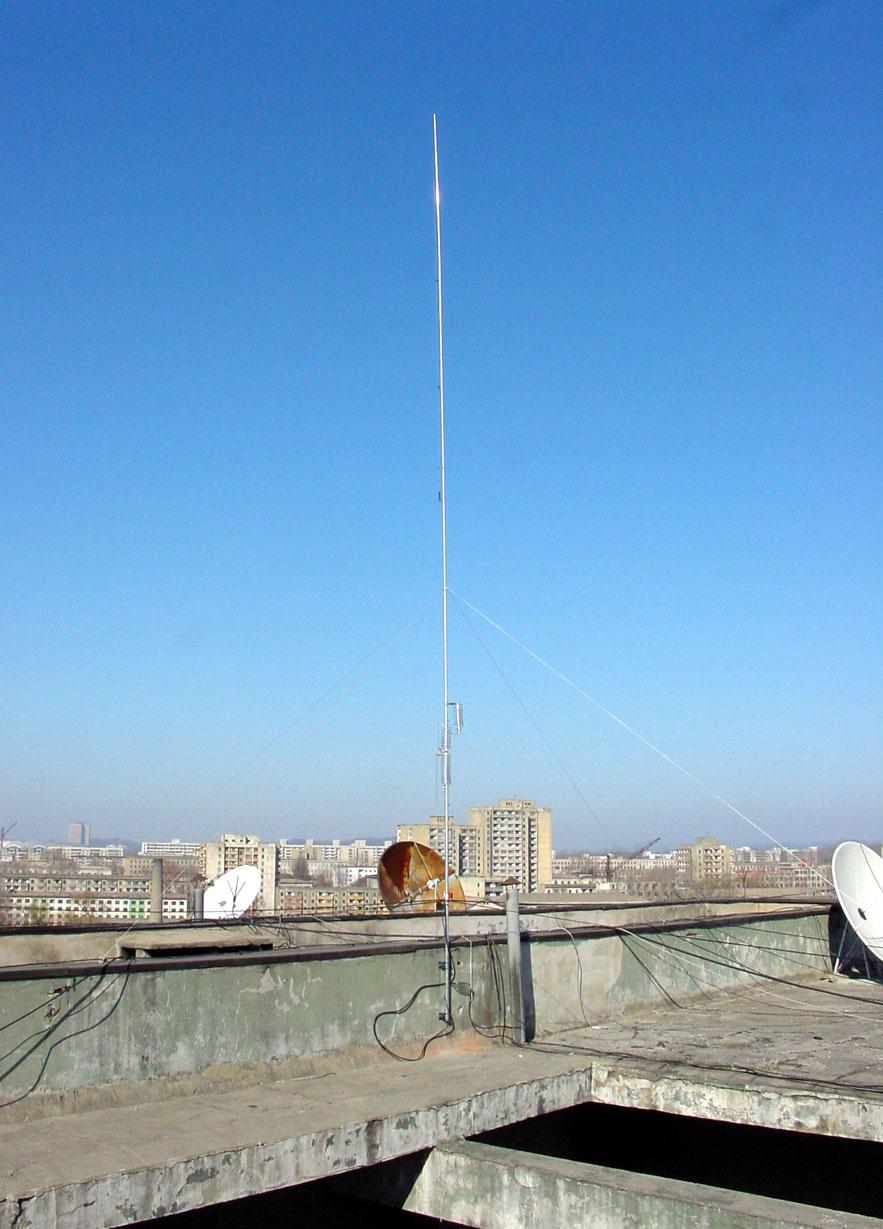
Here’s a couple of photos of the antennas he used:
The antenna of Edisher Giorgadze (4L4FN) at his amateur radio station in Pyongyang.